NSW Solar Feed In Tariff Information
Last Updated: 23rd Jul 2026
In NSW, electricity retailers don’t have to offer a solar feed-in tariff. But most do, and so they should! While there’s a lot more solar energy than in the past, it’s still valuable stuff.
While electricity retailers don’t have to pay a feed-in tariff in NSW, the Independent Pricing and Regulatory Tribunal (IPART) publishes a benchmark range for them. Here’s a graph showing what they’ve recommended over the years for a flat, daytime solar feed-in tariff:
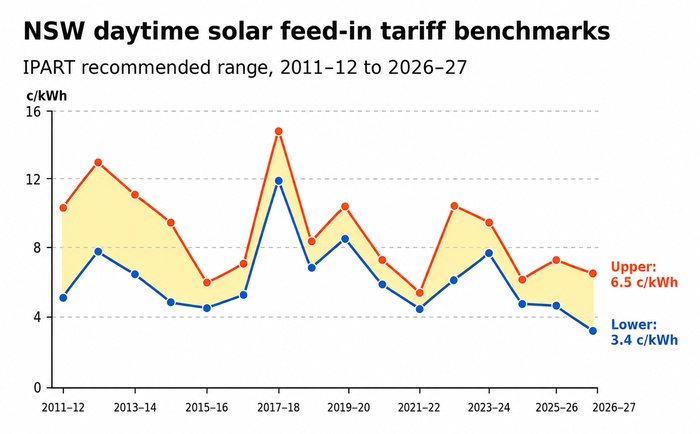 For the current 2026-27 financial year, it’s 3.4 to 6.5c/kWh. This is down from the previous financial year. While the benchmark feed-in tariffs on the graph above look like they’re all over the place, inflation means the general trend has been downwards in real terms. Note these are just benchmark ranges, and some electricity retailers may offer higher rates.
To investigate current feed-in tariff rates, you can use our electricity retailer comparison tool. It’s designed to show daytime solar and evening battery feed-in tariffs. It also allows you to compare plans with free daytime electricity periods.
Daytime Solar & Evening Battery Feed-in Tariffs
In the past, the purpose of feed-in tariffs was to reward households for supplying solar energy to the grid. But now home batteries are popular, electricity plans can have high feed-in tariffs in the late afternoon and evening when rooftop solar output can be low or zero. If you have solar without a battery, or aren’t interested in exporting battery power to the grid, it’s important not to mistake a high evening battery feed-in tariff for a daytime solar feed-in tariff.
Available Daytime Feed-in Tariffs
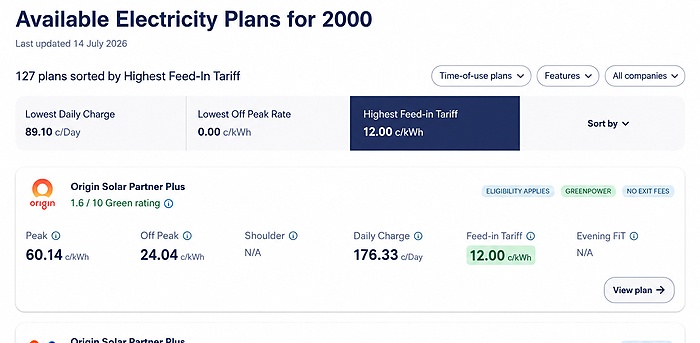
As of early July 2026, the residential electricity plan with the highest daytime feed-in tariff I’ve found is Origin Solar Partner Plus. However, this plan comes with some conditions…
- Origin Solar Partner Plus: 12c/kWh until you reach your export cap, which is 8 kWh for each day of the billing period. After that, solar exports receive Origin’s standard retailer feed in-tariff rate; which is currently 3c/kWh. Inverter capacity must be 10 kW or less. This is a 12 month plan that is only available if you’ve purchased a solar system through SolarQuotes. For transparency’s sake, I’ll mention SolarQuotes is an Origin Group company.
Some other options with high daytime feed-in tariffs are:
- GloBird SOLARPLUS Residential: 10c per kWh exported for the first 8 kWh per day in a billing period, then 3c/kWh after that.
- AGL Residential Solar Savers: 8c per kWh exported for the first 8kWh per day in a billing period, then 3c/kWh after that.
Note that when retailers say they’ll pay a higher feed-in tariff for a set number of kWh per day, they don’t actually look at the amount exported each day. Instead, they multiply the set number of kWh per day by the number of days in the billing period, and then pay the higher feed-in tariff for that amount. This is an advantage because solar exports can vary considerably from day to day.
Evening Battery Feed-in Tariffs
Here are some examples of residential electricity plans with high evening feed-in tariffs that may suit people with batteries who are happy to provide battery power to the grid in the late afternoon and evening:
- Flow Home Battery + Solar: 45c/kWh evening feed-in tariff from 5:30pm-7:30pm and 0c feed-in tariff at all other times. So, it’s not a good plan for those exporting a large amount of solar energy during the day.
- CovaU Solarmax NSW: 15c/kWh evening feed-in tariff from 6pm-9pm for first 30 kWh and 5c/kWh for exports over 30kWh each evening peak period and at all other times.
- GloBird FOUR4FREE Residential: 8c/kWh evening feed-in tariff from 4pm-11pm and 0c/kWh at all other times, which means it’s not a good plan for anyone exporting a large amount of solar energy during the day.
Households with suitable batteries also have the option of joining a Virtual Power Plant (VPP). One reason to consider it is that in NSW, there’s a state incentive to join one. VPPs may have their own evening battery feed-in tariff and possibly a daytime tariff. With the right battery, you can also join Amber Electric. This lets you sell energy from your battery at a price linked to the wholesale price of electricity, which can range from a negative price when too much power is supplied to the grid to over $19 per kWh when demand is especially high.
Be Sure To Shop Around
If you only have solar, or you have a battery but aren’t interested in discharging it to the grid in the evening, then normally you’ll want an electricity plan with a high daytime feed-in tariff. But the plan with the highest feed-in tariff won’t always be the best. It’s important to check the electricity rates and daily supply charge to make sure it is the best plan for you.
The easiest way to find a local retailer with a good solar buyback rate is to use the SolarQuotes Retailer Comparison Tool:
Old Generous Feed-in Tariffs Are Over
NSW used to have a generous high feed-in tariff to encourage solar uptake. Unlike other states, it wasn’t only received for surplus solar exported to the grid. Instead, it was a gross tariff that was paid for every kWh of solar electricity generated. From the 1st of January to the 27 of October 2010, NSW households could lock in a gross feed-in tariff of 60 cents a kilowatt-hour. After that, from the 28th of October 2010 to the 28th of April 2011, a gross feed-in tariff of 20 cents could be locked in.
Both of these ended on the 31st of December 2016.
If you were on one of these tariffs, you almost certainly had your old meter replaced years ago. But if you’re not certain this occurred, you can check your electricity bill to see if you’re receiving a solar feed-in tariff. If you aren’t and your electricity plan says you should be getting one, you can check with your electricity retailer that you have a meter configured to record exports. If you do have an old meter incapable that can’t handle exports, you can request a meter change from your electricity retailer. Charges may be minimal, but it’s important to check exactly what you’ll be charged before going ahead. Any new meter installed these days will be a smart meter. Alternatively, you can simply wait, and your old meter will eventually be replaced with a smart meter.
Options Now The Gross Feed-in Tariff Has Ended
Most solar power systems that received the high gross feed-in tariff incentive in New South Wales were quite small and usually around 3 kilowatts or less, with most being just 1.5 kilowatts. If you still have one of these and have an unshaded roof, I can almost guarantee you’ll be much better off with a larger system and, likely, a battery.